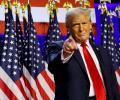
American President Donald Trump has announced imposing reciprocal tariffs on its major trading partners including China that levy higher import duties on goods shipped from the United States. He has already announced a 25 per cent duty on steel and aluminium imports, which will come into effect from March 12.

India and Russia on Tuesday set a target of $100 billion in annual trade volume by 2030 and vowed to develop a robust bilateral payment settlement mechanism using national currencies. The two sides also inked a total of nine agreements to further broadbase cooperation in a range of areas including in the economic domain following summit talks between Prime Minister Narendra Modi and Russian President Vladimir Putin.

Musk said on Friday that he believes India-US ties are "trending positive" and that he favours an enhanced trade partnership between the two nations.
Trump's sweeping tariffs and penalties on China-built ships have turned global shipping into the front line of economic war, observes Shyam G Menon.

The story of the Bombay Stock Exchange and the people who shaped its growth: From wars and bomb blasts to speculators, reformers and wealth creators.

President Droupadi Murmu's address to the nation on the eve of the 79th Independence Day.

USTR has said India imposed several barriers in major services industries such as insurance, banking, audiovisual, accounting, legal, telecommunications, distribution services, postal and express delivery services.

From toys, footwear and furniture to insulated flasks, smart meters, and air coolers - the Central government over the last decade has mandated higher standards for production and imports of such items. Sample this: Till 2014, there were 14 Quality Control Orders (QCOs) covering 106 products. By the latest count, there are 156 QCOs on 672 products.
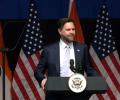
US Vice President JD Vance called on India to drop non-tariff barriers, give greater access to its markets and buy more American energy products and military hardware. Vance, in a speech in Jaipur, highlighted the need for a stronger US-India partnership for a prosperous and peaceful 21st century. He emphasized the importance of working together to address global challenges and praised Prime Minister Narendra Modi, describing him as a "special person." Vance also urged India to provide greater market access to American products and buy more defense platforms and energy from the US. He suggested that India consider dropping some of the non-tariff barriers for American access to the Indian market and highlighted the benefits of closer India-US defense collaboration, advocating for New Delhi to procure more military hardware from the US. He cited the example of American fifth-generation F-35s, arguing they would give the Indian Air Force the ability to defend its airspace and protect its people like never before. Vance also welcomed the Modi government's budget announcement to amend India's civil nuclear liability laws, paving the way for US producers to export small modular reactors and build larger US-designed reactors in India. He emphasized the importance of energy security for India's AI ambitions, stating "there is no AI future without energy security and energy dominance." Vance's visit comes amid growing global concerns over the US's tariff war.
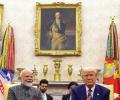
'Modi's intention was to create goodwill that will allow India to be seen by Trump as more than just a bad tariff problem.' 'He succeeded brilliantly on that count but none of these wins are unfortunately permanent.' 'Modi will have to do this again and again if Trump's grievances are to be durably assuaged.'

The "construct of the DPDP Act" cannot be changed at this stage, though there may be some minor tweaks in the language of the Rules and formats in certain legitimate cases.

The issues around trade gaps, especially around steel and aluminium tariffs imposed by the US, will be addressed separately.

India's drug policy of stringent price control regime is a major concern for United States industries because it creates obstacles to maintaining viable businesses in the country, according to a report by the United States Trade Representative.
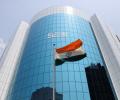
The Securities and Exchange Board of India's (Sebi's) six-step plan to curb retail participation in speculative index derivatives may lead to a substantial drop in volumes - potentially by 30-40 per cent. These measures aim to reduce excessive speculation in the futures and options (F&O) segment, where daily turnover often exceeds Rs 500 trillion and retail investors end up on the losing side of the trade more often. Sebi has decided to increase the contract size from Rs 5 lakh to Rs 15 lakh, raising margin requirements and mandating the upfront collection of option premiums from buyers.
'We may see even more restrictive policies during 2.0.'

With Donald Trump all set to become US president, Indian exporters may face high customs duties for goods like automobiles, textiles and pharmaceuticals if the new US administration decides to pursue the 'America First' agenda, opined trade experts. Experts also said that Trump could also tighten H-1B visa rules, impacting costs and growth for Indian IT firms. Over 80 per cent of India's IT export earnings come from the US, making it vulnerable to changes in visa policies.
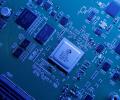
Tata Sons will likely choose Singapore as a "key partner" for its semiconductor plans, a senior minister from the city-state said on Friday. Speaking to reporters after a meeting with Tata Sons chairman N Chandrasekaran earlier in the day, Singapore's minister for home affairs and law K Shanmugam said semiconductors was a "big discussion" point during the meeting. "If they (Tatas) want to, they can do business with anybody in the world.

While the Trump administration wants India to lower the trade barriers and embrace "fair and reciprocal" trade, India has raised tariffs on 28 items exported from the US in retaliation to America's withdrawal of preferential access for Indian products.
The index could be vulnerable to a bigger fall given the present market dynamics.
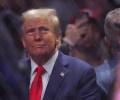
The impact of Trump's announcement of increasing import tariffs will have negligible benefit for India not because of companies trying to shift from China to other countries or their supply chains being affected due to their Chinese operations but because of our faulty policies, explains Mudit Jain.

Much on the expected lines, Beijing reacted angrily to Hands' visit, saying that it violates the one-China principle to which London is a signatory.

Biden, the first US Vice President to visit India in three decades, welcomed relaxation of foreign direct investment norms in certain sectors but said a lot more needed to be done to remove trade barriers.

The Union Cabinet on Wednesday approved the signing of a comprehensive economic cooperation agreement, a kind of a free trade pact, between India and Mauritius which is aimed at liberalising norms to boost two-way commerce
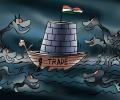
'We do India great disservice if we continue to perpetuate a flawed narrative on trade, one based on myths rather than facts,' says Hardeep Singh Puri.
Australia largely avoided the turmoil of the global financial crisis by leveraging Chinese demand for its abundant natural resources.

Our focus is not on substance, but communicating how we did not shake hands and how we made angry faces. This is what India's foreign policy has become, notes Aakar Patel.

This is a high-stakes strategic conflict between a power which wants to preserve the status quo in its favour and one which wants to usurp that throne. The rest is all theatre, says Harsh V Pant.

Shigeru Ishiba is expected to prioritise strengthening Japan's military capabilities and fostering deeper international partnerships, particularly with India, with whom Japan shares significant strategic interests, explains Dr Rajaram Panda.

The proposed policy is increasingly becoming an item of negotiation, as the US pushes hard to change India's stance.

A Priority Foreign Country is a status reserved for those nations that are the most egregious violators of intellectual property rights and have the most negative impact on US competitiveness abroad.

Mr Prabhu has a big challenge ahead in implementing trade reforms to regain the lost export momentum, says Jayanta Roy.
Notwithstanding the growing political ties, China has accused India, its biggest trade partner in South Asia, of carrying out restrictive trade practices, including technical barriers, opaque and complicated regulations
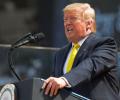
Addressing the 'Namaste Trump' event at the Motera Stadium in Ahmedabad, Trump said that both the countries are in the early stages of discussion for an 'incredible' trade agreement to reduce barriers of investments.

Chidambaram expressed India's discomfort on the immigration issue
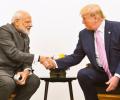
Trump congratulated Modi on his election victory and said that the two countries would work together in many areas including military.

Pakistan on Friday pitched for liberalising visa regime with India and expressed willingness to accord non-discriminatory market access (NDMA) to New Delhi soon to boost bilateral trade.

China's GDP jumped a record 18.3 per cent in the first quarter of 2021, riding on strong domestic and foreign demand and aided by recovery from a low base in early 2020 when Covid-19 stalled the world's second-largest economy, according to statistics released on Friday.
A federal body began a hearing on the impact of Indian trade policies on US businesses wherein American bodies and advocacy groups slammed India for its trade practices, alleging they hit their jobs and business.
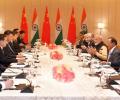
China had been trying hard to enter the Indian market, without opening its own to Indian products. There is an economic crisis in India-China relations that the Chennai Connect barely scratched the surface, points out Srikanth Kondapalli.
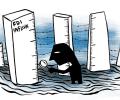
Foreign direct investment into the country is expected to rebound in the coming months on account of India's high economic growth, and steps to further improve the business environment of India, the Economic Survey said on Tuesday. The rise in global uncertainty in the wake of the Russia-Ukraine conflict, FDI equity inflows in the manufacturing sector in the first half of the current fiscal (April-September) fell below its corresponding level in the first half of 2021-22, the document, which was tabled in Parliament, said. The monetary tightening at the global level has further restricted the FDI equity inflows, the survey said.
 © 2026 Rediff.com - Advertise with us - Disclaimer - Privacy Policy - Sitemap - Feedback - About us - Terms of use - Grievances